
Understand commercial painting terms: smarter project choices

TL;DR:
Knowing painting terminology helps property managers communicate effectively and assess project quality.
Understanding specifications and standards ensures accurate quotes and long-lasting, high-quality finishes.
Verifying contractor credentials like BBA and PDA guarantees reliable, compliant, and regionally experienced work.
Most property managers and homeowners assume the technical side of commercial painting is best left entirely to contractors. That assumption costs money. When you walk into a project discussion without knowing what terms like DFT, VOC, or surface prep actually mean, you’re relying entirely on someone else to define quality on your behalf. This guide gives you the vocabulary to hold your own in those conversations, compare quotes with confidence, and spot the difference between a contractor who genuinely knows their craft and one who hides behind impressive-sounding language. Understanding the right terms is one of the most practical things you can do before a single brush touches a wall.
Table of Contents
Key Takeaways
Point | Details |
Understanding saves money | Knowing commercial painting terms empowers you to compare bids and avoid costly surprises. |
Specifications matter | Details like VOC compliance and surface prep standards ensure project quality and safety. |
Quality lasts longer | Premium paints and good practice add years to your finish compared to budget solutions. |
Check UK credentials | Always verify contractor certifications like BBA or PDA for reliable outcomes. |
Why terminology matters in commercial painting projects
Imagine receiving two quotes for the same job. One mentions “full surface preparation to commercial standards” and the other simply says “prep and paint.” Both sound reasonable. But without knowing what surface preparation actually involves, you have no way of knowing which contractor is promising more. That gap in knowledge is where quality gets lost and budgets get stretched.
Knowing key terms affects your project in three direct ways:
Communication: When you use the correct terminology, contractors respond with more precise answers. Vague questions get vague answers.
Timeline: Understanding what each preparation or application stage involves helps you set realistic expectations and hold contractors to agreed schedules.
Cost control: Jargon can mask shortcuts. A contractor who omits adhesion testing or skips a primer coat may never mention it unless you ask specifically.
One of the most useful distinctions to understand early is the difference between prescriptive and performance specifications. As noted in commercial painting project specifications, prescriptive specs limit bidding competition but reduce risk, while performance specs allow flexibility but increase verification. In plain terms: prescriptive specs tell a contractor exactly what to use and how, while performance specs define the outcome you want and leave the method to them. Knowing which type your quote is based on tells you a great deal about how much control you actually have.
This matters even more in professional painting explained contexts, where the difference between a vague brief and a tightly specified one can mean the difference between a finish that lasts a decade and one that starts peeling within two years.
“The single biggest source of disappointment in commercial painting projects is not the paint itself. It is the gap between what a client assumed was included and what the contractor actually priced for.”
Pro Tip: Before signing any quote, ask your contractor to define every technical term they have used in writing. If they cannot or will not, that tells you something important about how they work.
Industry jargon can also obscure hidden costs. Terms like “spot prime” versus “full prime” sound similar but represent very different levels of preparation. A spot prime covers only visible problem areas, while a full prime coats the entire surface. The cost difference is significant, and the quality difference is even more so.
Now that you know the benefits of mastering painting terms, let’s clarify the most common language you will encounter.
Glossary of essential commercial painting terms
With a foundation for why terms matter, here is your plain-language glossary to keep handy. These are the terms most likely to appear in quotes, contracts, and site meetings.
Term | What it means | Question to ask your contractor |
SSPC/NACE | Industry standards for surface preparation, especially on steel | “Which SSPC standard are you working to?” |
SP-6 | Commercial blast cleaning level for steel surfaces | “Is SP-6 included in your surface prep?” |
DFT | Dry film thickness, measured after paint cures | “What DFT are you specifying per coat?” |
WFT | Wet film thickness, measured during application | “How will you monitor WFT on site?” |
Mock-up | A sample panel painted for client approval before full application | “Can we agree a mock-up before you start?” |
VOC | Volatile organic compounds, a measure of paint emissions | “Does this paint meet VOC compliance below 250g/L?” |
Adhesion testing | Checks how well paint bonds to a surface | “Will you carry out adhesion testing before and after?” |
Holiday detection | Identifies gaps or pinholes in a coating | “Is holiday detection part of your quality check?” |
As commercial painting project specifications outline, these standards cover everything from surface prep grades to VOC compliance thresholds, and each one has a direct bearing on how long your finish will last.
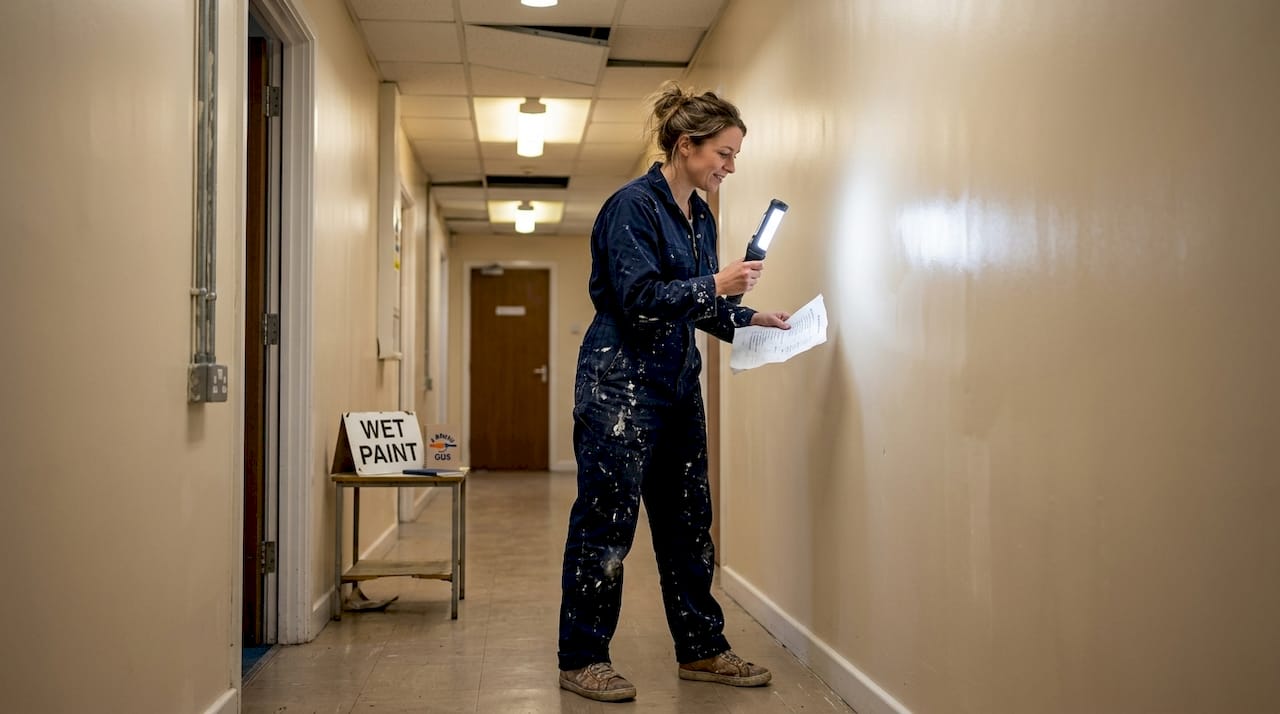
The top five terms most likely to come up in your first contractor meeting are VOC, DFT, surface prep grade, mock-up approval, and prescriptive versus performance specs. If a contractor cannot explain any of these clearly, ask them to. A good contractor welcomes the question.
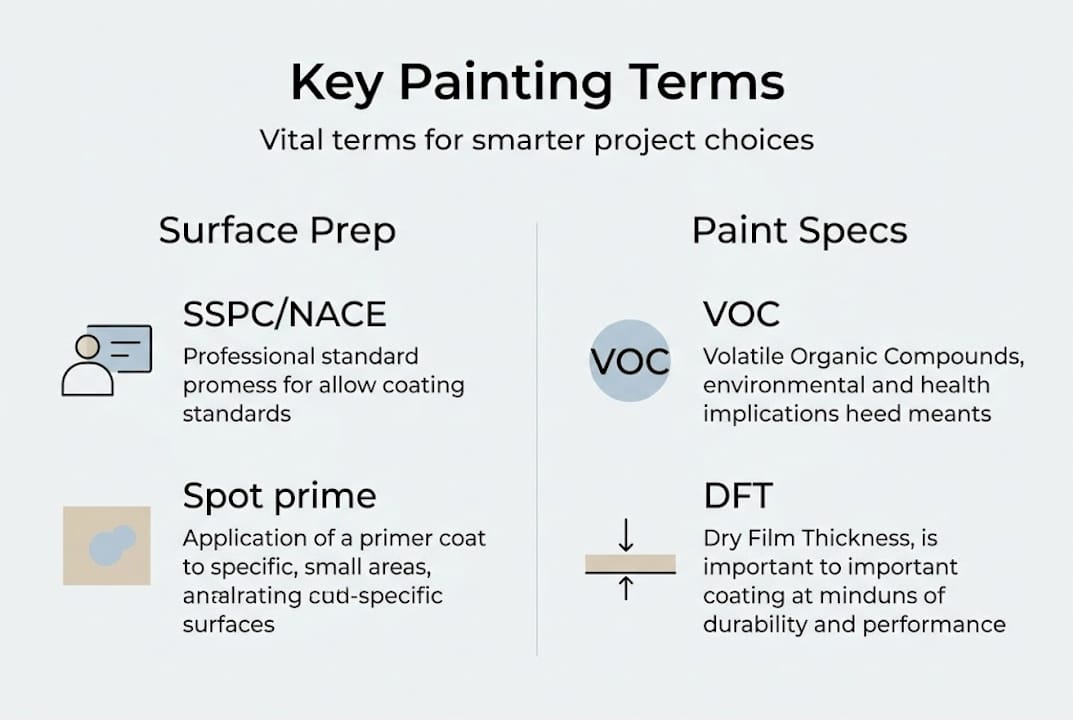
Using this glossary in early conversations does more than impress. It signals that you are an informed client, which tends to produce more thorough proposals and fewer assumptions. You can find more detail on application methods in our painting techniques guide, and if you are comparing commercial and residential painting basics, the terminology overlaps more than you might expect.
Comparing paint types, specifications, and cost implications
Now you are equipped with essential vocabulary, let us compare how your choices affect project outcomes beyond the jargon.
The decision between premium and budget paint is rarely just about upfront cost. Premium paints last 5 to 8 years compared to just 2 to 3 years for budget alternatives. Over a ten-year period, a budget paint job may need to be redone three times, while a premium finish might only need one refresh. The maths shifts considerably when you factor in labour, disruption, and surface preparation each time.
Factor | Premium paint | Budget paint |
Lifespan | 5 to 8 years | 2 to 3 years |
Maintenance frequency | Low | High |
VOC compliance | Usually meets or exceeds standards | Variable |
Coverage per litre | Higher | Lower |
Long-term cost | Lower | Higher |
Specification type also plays a role. A prescriptive spec locks in the exact products and methods, giving you more predictability. A performance spec focuses on the end result, which can work well if your contractor is experienced but introduces more variability if they are not.
Here is a straightforward four-step process for discussing paint types with any contractor:
Ask for the product data sheet for every paint they plan to use. This confirms VOC levels, DFT requirements, and expected lifespan.
Request a written specification that states whether it is prescriptive or performance-based.
Compare maintenance cycles across the options they present, not just the initial price.
Check environmental compliance, particularly if the property is used commercially and subject to indoor air quality regulations.
For more guidance on making the right product choice, our article on choosing paint for businesses breaks down the decision in practical terms. You may also find our overview of types of interior paints useful when reviewing contractor proposals.
UK standards, certification, and what to ask local contractors
Armed with technical and cost insights, ensure your contractor meets UK standards for results and reliability.
In the UK, two markers stand out as reliable indicators of quality. BBA certification and PDA membership signal that a contractor operates to defined workmanship codes and has their processes independently assessed. The British Board of Agrément (BBA) certifies products and systems for performance, while the Painting and Decorating Association (PDA) sets professional standards for tradespeople.
When vetting contractors in the South West, look for these four credentials:
PDA membership, which confirms adherence to a recognised code of practice
BBA-certified products in their specification
Evidence of adhesion testing using recognised methods such as ASTM D4541
Surface prep documentation showing compliance with SSPC SP-6 or higher for any steel or industrial surfaces
“Membership of the PDA demonstrates a commitment to raising standards across the industry, giving clients confidence that the work will be carried out professionally and to a high standard.” Painting and Decorating Association
Pro Tip: Always ask to see photographic evidence or written records from recent jobs where these standards were applied. Any reputable contractor will have this readily available.
The South West market has its own character. Coastal environments in areas like Cornwall and Devon introduce higher moisture and salt exposure, which makes surface preparation and primer selection even more critical than in inland locations. A contractor familiar with local conditions will factor this into their specification without being asked. One who does not mention it at all may not have the regional experience you need.
For more on what separates reliable tradespeople from the rest, our guide on trusted contractors quality covers what to look for in practical detail.
Our perspective: why project clarity beats flashy jargon
Years working across the South West have shown us one consistent pattern: most quality issues do not start with the wrong paint. They start with unclear conversations at the beginning of a project. A contractor who uses impressive terminology without being able to back it up with specifics is a red flag, not a reassurance.
The best projects we have been involved with share one quality: every party knew exactly what was being done, why, and how it would be measured. That clarity comes from asking direct questions and insisting on written answers. Our guide on understanding local contractors reflects exactly this approach.
Our favourite questions to recommend to property managers and homeowners are simple: “Can you show me that in writing?” and “What does that standard actually require on this job?” Those two questions alone have saved clients from vague commitments more times than we can count. The more precise your brief, the less room there is for disappointment. Jargon should clarify, not obscure. If a term in your quote confuses you, it deserves a plain-English explanation before you sign anything.
Need help navigating painting projects in the South West?
Understanding painting terminology puts you in a far stronger position when discussing any project. But knowing the terms is only the first step.

At A Brush With Gus, Gus and Rhys work with homeowners and property managers across the South West to make every project straightforward and jargon-free. Whether you need advice on surface preparation, want to understand what is included in a quote, or are ready to get started, we are happy to talk it through in plain English. Our modern spraying solutions and pre-paint cleaning services are built around clear communication and quality results. Get in touch for a no-fuss conversation or a detailed quote today.
Frequently asked questions
What does SSPC SP-6 mean in a commercial painting quote?
SSPC SP-6 is a surface preparation standard specifying commercial blast cleaning for steel, ensuring the surface is clean enough for paint to bond properly and last as intended.
Why is VOC compliance important in commercial painting?
VOC compliance ensures paint emissions stay within safe limits, protecting indoor air quality and meeting legal requirements, particularly relevant for occupied commercial buildings.
How long does premium commercial paint typically last?
Premium commercial paints last around 5 to 8 years, while budget alternatives typically need replacing after just 2 to 3 years, making premium a more cost-effective choice over time.
Which UK certifications show a contractor’s reliability?
BBA certification and PDA membership are the two most meaningful markers, confirming that a contractor follows recognised workmanship codes and uses independently assessed products and systems.
Recommended
Comments