
Enhance your home: a complete guide to interior decorating

TL;DR:
Interior decorating enhances home aesthetics, comfort, functionality, and property value.
Key elements include colour, lighting, textiles, furniture, and accessories, combined using the 60-30-10 rule.
Professional decorating offers durability and quality, especially for historic or large-scale projects.
Most homeowners in the South West UK assume that freshening up a room means a quick coat of paint or shuffling furniture around. The reality is quite different. Interior decorating is a layered discipline that shapes how your home feels, functions, and even how much it is worth. From the way light bounces off a carefully chosen wall colour to the way textiles soften a hard-floored room, every decision connects. This guide cuts through the confusion, explains what interior decorating truly involves, and gives you practical, actionable knowledge to transform your living spaces with confidence.
Table of Contents
Key Takeaways
Point | Details |
Clear definition | Interior decorating is about enhancing aesthetics and functionality with coordinated elements. |
Essential elements | Colour, lighting, textiles, and accessories work together to transform living spaces. |
Local expertise | Addressing specialist needs of South West UK homes ensures long-lasting results. |
DIY versus professional | Professionals deliver durability and guaranteed results; DIY suits simple projects if skilfully managed. |
Attention to detail | Subtle touches can have the greatest impact on home style and value. |
Defining interior decorating and its benefits
Let’s start with a clear foundation. Interior decorating is the art and science of enhancing a building’s interior to create a more aesthetically pleasing and functional environment. That definition matters because it tells you something important: decorating is both creative and technical. It is not simply about personal taste.
Many people confuse interior decorating with interior design, and the two roles do overlap in the UK. According to House & Garden UK, the distinction between decorators and designers is fluid here. Generally speaking, interior designers work with structural and architectural elements, while decorators focus on movable, portable aesthetics such as colour, furniture, and textiles. For most homeowners, a skilled decorator is exactly what they need.
“Interior decorating is the art and science of enhancing a building’s interior to create a more aesthetically pleasing and functional environment.” — Cambridge Dictionary
So why does it matter for your home? The benefits go well beyond appearance. A well-decorated room is more comfortable to live in, easier to keep tidy, and can genuinely increase your property’s market value. Estate agents across the South West consistently note that well-presented interiors attract stronger offers and faster sales.
Here are the practical benefits for homeowners:
Improved comfort: Thoughtful choices in furniture, lighting, and textiles make rooms feel welcoming rather than cold or cluttered.
Better functionality: Good decorating considers how you actually use a space, not just how it looks in photographs.
Increased property value: A refreshed interior signals care and quality to potential buyers.
Personal wellbeing: Colour psychology research shows that your surroundings directly influence mood and stress levels.
Energy efficiency: Clever use of light and reflective surfaces can reduce your reliance on artificial lighting.
For a deeper understanding of how professional painting fits into this picture, the professional painting guide on our website is a useful starting point. You should also consider the qualities of a good painter when planning any decorating project, because the person applying the paint matters just as much as the paint itself.
Essential elements of interior decorating
With a clear understanding of what interior decorating means, let’s look at its core components and how they work together.
The selection and arrangement of interior elements is what creates spaces that feel both pleasing and functional. No single element works in isolation. A beautiful colour scheme falls flat under poor lighting. Stunning furniture looks wrong in a room with clashing textiles. It is the combination that counts.
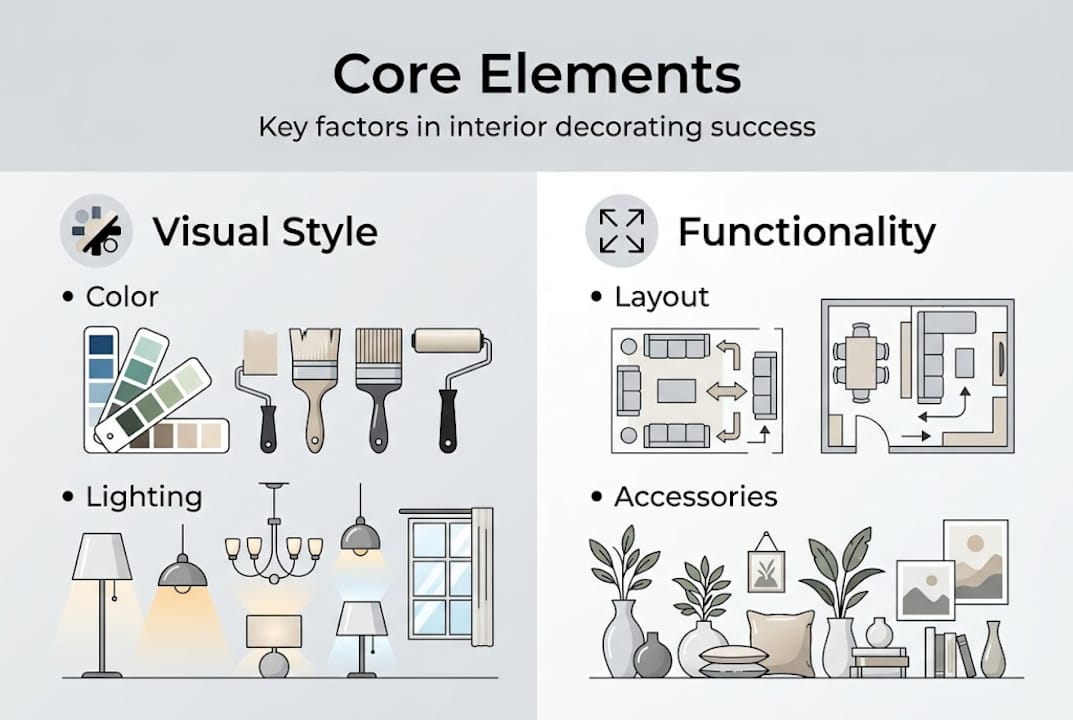
Element | Key feature | Primary function |
Colour | Sets mood and visual scale | Defines atmosphere and perceived room size |
Lighting | Natural and artificial sources | Enhances depth, warmth, and task performance |
Textiles | Curtains, rugs, cushions | Adds softness, warmth, and acoustic comfort |
Furniture | Scale, shape, and placement | Determines flow and practical use of space |
Artwork | Focal points and personality | Adds character and visual interest |
Pro Tip: Use the 60-30-10 colour rule to achieve balanced rooms. Choose a dominant colour for 60% of the space (walls, large furniture), a secondary colour for 30% (soft furnishings, curtains), and an accent colour for the remaining 10% (cushions, artwork, accessories). This simple framework prevents rooms from feeling either bland or overwhelming.
Here is how each element contributes to the overall ambience:
Colour sets the emotional tone before anyone sits down or touches anything.
Lighting changes how every other element is perceived, especially in the evening.
Textiles introduce texture, which adds depth and prevents a room from feeling flat.
Furniture dictates how people move through and use a space on a daily basis.
Artwork and accessories are the finishing touches that make a house feel like a home.
Accessorising is often underestimated. A well-chosen mirror, a carefully placed plant, or a cluster of framed prints can pull a room together without any structural changes. For inspiration tailored to local homes, browse our painting ideas for South West UK homes. You can also explore our paint types explained article and visit our decorating tips blog for ongoing guidance.
Paints, colours, and specialist techniques for South West UK homes
Paint is the single most transformative tool in interior decorating, and the South West presents some specific considerations worth knowing about.
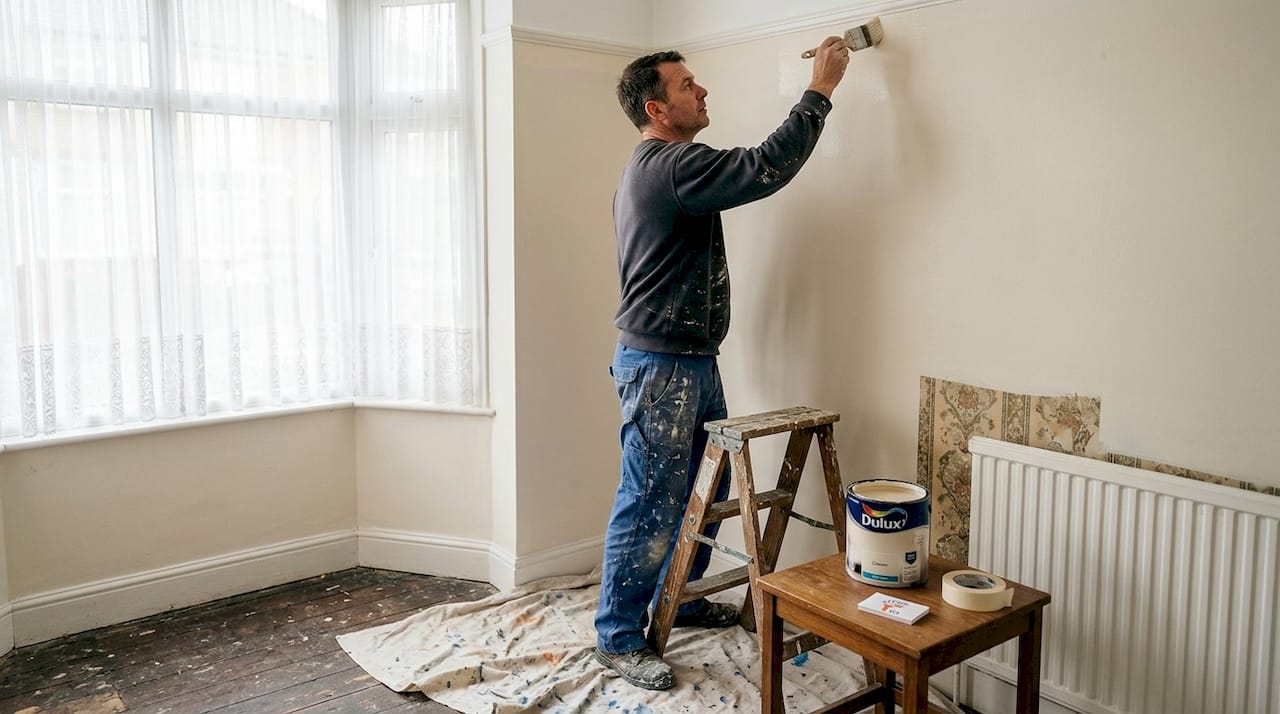
If your home has been recently plastered, patience is essential. New plaster needs 2 to 4 weeks to dry fully before painting. Applying paint too early traps moisture, leading to peeling and discolouration. Period properties, which are common across Bath, Bristol, and the wider South West, often require breathable paints to prevent damp from becoming trapped within older walls. Knotting solution is essential on bare timber to stop resin bleed. These are not minor details. They are the difference between a finish that lasts five years and one that starts failing within twelve months.
Paint type | Best suited for | Key benefit |
Breathable emulsion | Period and stone properties | Allows moisture to escape |
Low-VOC emulsion | Family homes, bedrooms | Better indoor air quality |
Eggshell or satin | Kitchens, hallways | Durable and easy to clean |
Matt emulsion | Living rooms, ceilings | Hides imperfections effectively |
Specialist masonry paint | Exterior walls | Weather-resistant finish |
To make rooms feel larger, follow these steps:
Paint the ceiling a shade lighter than the walls to draw the eye upward.
Use a single colour throughout connected spaces to create visual flow.
Choose cool or neutral tones, which recede visually and open up a room.
Avoid dark feature walls in already small rooms unless balanced with strong lighting.
Use gloss or satin finishes on woodwork to reflect light and add brightness.
Pro Tip: Colour drenching, painting walls, ceiling, and woodwork in the same shade, is a bold technique that works particularly well in compact South West cottages and terraced homes. Far from making a room feel smaller, it creates a cocooning effect that feels intentional and modern.
For detailed guidance on choosing the right products, our interior paint types article covers the full range. When you are ready to apply, our guide to painting walls professionally walks you through the process step by step.
DIY vs professional interior decorating: choosing the best approach
This is the question most homeowners wrestle with, and the honest answer depends on your specific situation.
Factor | DIY | Professional |
Upfront cost | Lower initially | Higher upfront, better long-term value |
Finish quality | Variable | Consistently high |
Durability | Depends on skill | Backed by experience and technique |
Access to trade prices | No | Yes, often significant savings on materials |
Guarantees | None | Typically offered by reputable firms |
Time investment | High | Minimal disruption to your routine |
As House & Garden UK notes, the DIY versus professional debate often comes down to trade access, guarantees, and the true cost of time. Many homeowners underestimate how much their own time is worth.
“The cost of fixing a poor DIY finish often exceeds what a professional would have charged in the first place.”
Common misconceptions on both sides:
DIY myth: Painting is easy and anyone can achieve a professional result with a good brush.
DIY reality: Preparation, priming, and technique account for 80% of the final result.
Professional myth: Hiring a decorator is only for large or expensive projects.
Professional reality: Even small rooms benefit enormously from professional preparation and application.
DIY is perfectly suitable for small touch-up jobs, low-traffic rooms, or when budget is genuinely tight. However, for period properties, large open-plan spaces, or any project where quality and longevity matter, a professional is the wiser investment. Our article on the benefits of professional painters outlines this in detail. You can also explore the latest painting techniques for 2026 and our painting walls guidance to understand what a professional brings to the table.
Why small details define successful interior decorating
Here is something most decorating guides skip over entirely: the details that seem minor are often the ones that determine whether a finish lasts or fails.
We have worked on homes across the South West, from Georgian townhouses in Bath to modern new-builds in Exeter. The difference between a good result and a great one almost always comes down to preparation and problem-solving before the brush even touches the wall. Drying times, knotting solutions, and breathable paints are not optional extras. They are fundamental to durability.
Skilled decorators also read a property. They notice where damp might be lurking behind a skirting board, where a previous owner used the wrong primer, or where a period cornice needs careful masking. These are things you cannot learn from a YouTube tutorial.
The qualities of a good painter are not just technical. They include the ability to anticipate problems, communicate clearly with homeowners, and adapt their approach to the specific quirks of each property. That adaptability is what separates a decorator who delivers lasting results from one who simply applies paint and moves on.
Do not let the visual drama of a colour reveal distract you from the unglamorous work that makes it possible.
Transform your home with local painting and decorating experts
If this guide has helped you see your home’s potential more clearly, the next step is finding the right people to help you realise it.
At A Brush With Gus, Gus and Rhys bring genuine expertise and local knowledge to every project across the South West. Whether you need domestic decorating services for your interiors, specialist spraying services for a flawless finish on cabinetry or UPVC, or professional exterior home painting to boost your kerb appeal, the team is ready to help. Get in touch for a no-obligation quote and see what a difference the right professionals make.
Frequently asked questions
What does interior decorating involve in a UK home?
Interior decorating involves choosing and arranging colours, furniture, lighting, textiles, and accessories to create comfortable and stylish living spaces that reflect both your personality and practical needs.
How long should you wait before painting new plaster?
You should wait 2 to 4 weeks for new plaster to dry fully before applying paint, as painting too early traps moisture and causes the finish to fail prematurely.
Is there a difference between an interior decorator and interior designer?
In the UK the roles can be fluid, but broadly speaking decorators focus on movable aesthetics like colour and furnishings, while designers address structural and architectural elements of a space.
Should I use low-VOC paints in my home?
Low-VOC paints are strongly recommended for better indoor air quality, and are especially important in bedrooms, children’s rooms, and homes with allergy sufferers.
What is the 60-30-10 colour rule?
The 60-30-10 rule means using 60% dominant colour across walls and large furniture, 30% secondary colour in soft furnishings, and 10% accent colour in accessories for a well-balanced, cohesive room.
Recommended
Comments